
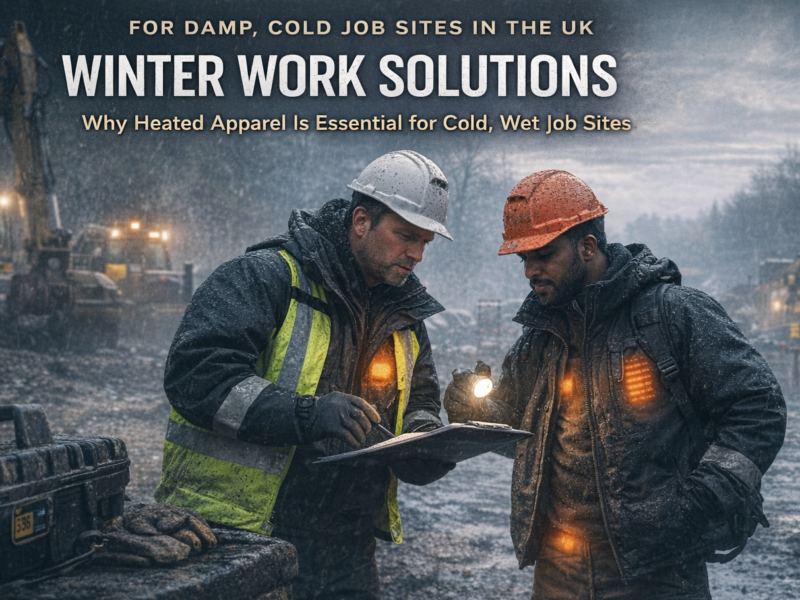
1. The Reality of UK Winter Work Conditions
Winter in the UK is not defined by heavy snow. Instead, it is characterized by persistent damp cold.
As a result, construction workers, warehouse operators, rail maintenance teams, and field engineers often face:
- High humidity
- Continuous drizzle
- Cold winds
- Long exposure hours
- Limited access to heated shelters
Unlike dry winter climates, damp cold penetrates traditional insulated garments more aggressively. Consequently, workers experience faster body heat loss and reduced comfort.
For B2B buyers, therefore, the requirement becomes clear:
Workwear must actively generate heat, not merely retain it.
2. Why Traditional Insulated Clothing Is Not Enough
Traditionally, winter workwear in the UK relies on fleece, down, or synthetic insulation. However, moisture significantly reduces insulation efficiency.
Once garments absorb damp air, their thermal performance declines. In other words, passive insulation becomes unstable in humid environments.
For this reason, heated apparel solutions provide a measurable advantage.
Not only do they generate active heat, but they also allow adjustable temperature control. Furthermore, modern heating systems maintain stable warmth regardless of humidity levels.
As a result, workers require fewer layers, which improves mobility and reduces fatigue during extended shifts.
3. What UK Buyers Expect from Heated Apparel OEM Suppliers
When evaluating OEM partners, British B2B buyers focus on several critical factors.
First, safety compliance is non-negotiable. This includes CE certification, battery protection systems, and overheat prevention mechanisms.
Second, durability is essential. Since garments are exposed to damp environments daily, water-resistant fabrics and reinforced stitching are required.
In addition, battery performance plays a decisive role. Buyers expect 6–10 hours of stable heating output under cold and humid conditions.
Finally, customization capabilities influence procurement decisions. Private labeling, logo printing, and seasonal packaging support are increasingly standard requirements.
Therefore, OEM suppliers must demonstrate not only product functionality but also structured quality control systems and stable manufacturing capacity.
4. Growing Procurement Trends in the UK Market
In recent years, heated apparel adoption has accelerated across multiple industries.
For example, construction companies increasingly procure heated jackets.
Meanwhile, logistics operators prefer heated vests to maintain flexibility.
At the same time, railway maintenance teams adopt heated base layers for prolonged outdoor tasks.
This shift indicates a broader transition. Previously, procurement decisions were primarily cost-driven. Now, however, buyers emphasize performance and worker well-being.
The logic is straightforward:
Better warmth leads to higher productivity.
Higher productivity reduces absenteeism.
Ultimately, improved comfort contributes to enhanced workplace safety.
5. Selecting the Right Heated Apparel OEM Partner
Given these market developments, choosing the right OEM partner becomes strategic rather than transactional.
Before committing, UK buyers typically assess production scalability and R&D capability.
Additionally, they evaluate compliance documentation and battery safety certification.
Lead time reliability is another decisive factor. After all, winter demand peaks leave little margin for delay.
Therefore, long-term cooperation depends on consistent quality, transparent communication, and stable supply chains.
6. Final Thoughts
In the UK’s damp winter work environments, passive insulation alone is no longer sufficient.
Instead, heated apparel is becoming a core category in professional workwear procurement.
For OEM suppliers targeting the UK market, understanding environmental pain points is critical. At the same time, technical reliability and compliance must meet industrial standards.
Only when both factors align can suppliers build sustainable partnerships in the UK heated apparel OEM market.
Recent Comments