
Why Global Markets Require Different Apparel Strategies
Functional apparel demand varies across regions. For example, climate and industry structure directly influence product requirements.
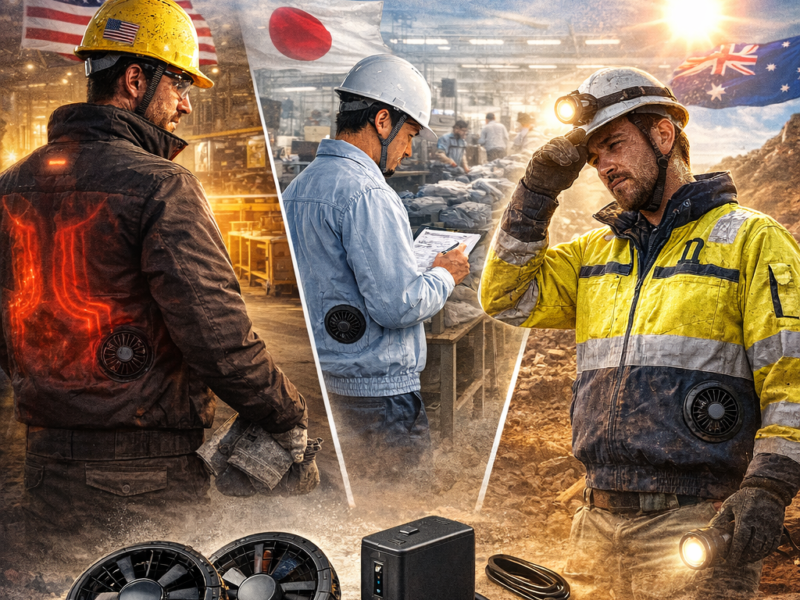
The United States focuses on heated apparel for winter operations. In contrast, Japan prioritizes cooling apparel for humid summer environments. Meanwhile, Australia requires cooling solutions for extreme heat and operates on a counter-season cycle.
Because of these differences, companies cannot rely on a single product strategy. Instead, they must adapt to each market.
Key Differences Between USA, Japan, and Australia
Understanding regional demand helps buyers select the right OEM partner. In addition, it improves long-term supply planning.
United States: Heated Apparel and Industrial Scale
The U.S. market emphasizes large production volumes and stable supply chains. Therefore, OEM partners must demonstrate:
- Scalable manufacturing
- Battery safety compliance
- Industrial durability
As a result, suppliers who offer consistent production gain stronger trust.
Japan: Precision and Technical Standards
Japanese buyers expect precision and consistency. For this reason, they focus on:
- Testing data
- Product uniformity
- Quality control systems
Moreover, even small inconsistencies may affect long-term cooperation.
Australia: Extreme Heat and Seasonal Timing
Australia presents extreme heat conditions. At the same time, its counter-season cycle creates unique supply challenges.
Buyers require:
- Heat-resistant materials
- Reliable cooling systems
- Flexible delivery timing
Therefore, OEM planning must align with seasonal demand.
Why OEM Capability Determines Market Success
Across all markets, OEM capability directly affects results. In particular, buyers evaluate:
- Customization options
- Production capacity
- Quality consistency
- Supply chain stability
In addition, suppliers must respond quickly to seasonal demand changes.
Otherwise, delays may result in lost orders.
Building a Stable Global Supply Strategy
Companies operating across multiple regions need structured planning. First, they must align production with seasonal demand cycles.
For example, Japan requires summer delivery, while the U.S. prepares for winter sourcing.
Second, companies must maintain consistent product quality across heated and cooling apparel.
Finally, they should work with OEM partners who understand global logistics and manufacturing coordination.
Why Long-Term OEM Partnerships Matter
Short-term sourcing creates uncertainty. In contrast, long-term OEM partnerships provide stability.
Reliable suppliers support:
- Continuous product improvement
- Cost control
- Predictable production
- Faster response times
As a result, companies build stronger market competitiveness over time.
Choosing the right functional apparel OEM partner requires more than price comparison.
Instead, companies must evaluate manufacturing strength, technical expertise, and global supply capability.
In summary, OEM suppliers who understand the needs of the USA, Japan, and Australia markets can help businesses build stable supply chains and achieve long-term growth.
Recent Comments