
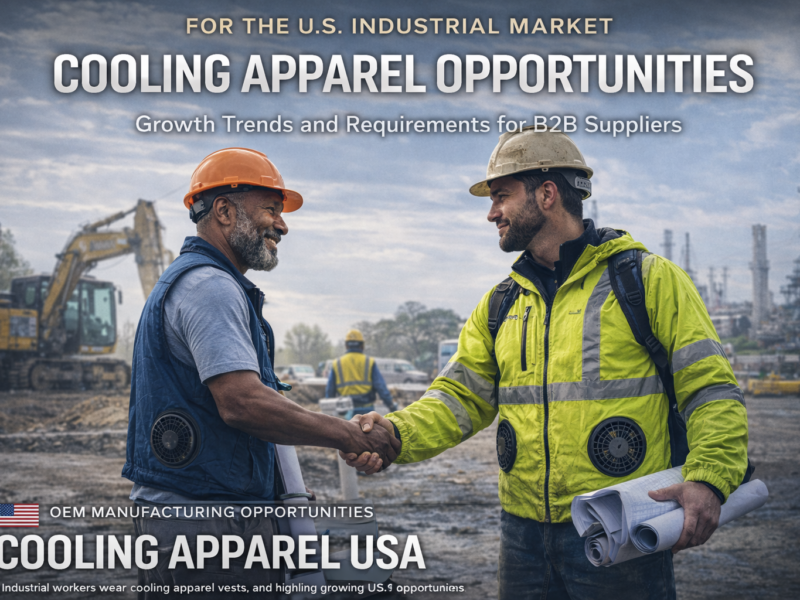
1. Rising Demand for Cooling Apparel in the U.S.
The United States has experienced increasing summer heat intensity in recent years.
As a result, industries with prolonged outdoor exposure face growing productivity and safety challenges.
Construction crews, logistics operators, agricultural workers, and infrastructure maintenance teams all require heat management solutions.
Therefore, cooling apparel is shifting from optional gear to essential equipment in many industrial sectors.
2. Application Expansion Across Multiple Industries
Unlike niche markets, the U.S. cooling apparel demand spans multiple sectors.
For example:
- Construction companies adopt fan-integrated vests.
- Warehouse operators use lightweight cooling jackets.
- Agricultural teams prefer breathable long-sleeve systems.
- Utility service providers integrate cooling garments into safety uniforms.
Because of this wide application range, OEM production partners must offer flexible design capabilities.
3. What U.S. B2B Buyers Expect from OEM Partners
U.S. buyers typically evaluate suppliers based on scalability and responsiveness.
First, production capacity must support seasonal volume spikes.
Second, compliance documentation is required for battery-powered cooling systems.
In addition, buyers expect clear communication regarding lead times and customization options.
Furthermore, private labeling and brand packaging flexibility often influence final supplier selection.
4. Product Requirements in the U.S. Market
While Japan emphasizes precision tolerance, the U.S. market prioritizes performance practicality.
Specifically, buyers focus on:
- Airflow efficiency
- Battery runtime
- Durability under heavy use
- Washability
- Comfort during long shifts
Therefore, OEM factories must balance technical stability with large-scale manufacturing efficiency.
5. Competitive Advantage Through Production Stability
Because U.S. procurement cycles can be aggressive, delivery reliability becomes a major competitive factor.
Suppliers who maintain stable supply chains and transparent scheduling gain long-term partnerships.
Moreover, responsive engineering support allows faster product iteration, which strengthens B2B cooperation.
Cooling apparel OEM opportunities in the U.S. industrial market continue to expand.
However, success depends on production scalability, compliance readiness, and structured communication.
Manufacturers who align technical capability with market application needs can secure sustainable growth in the U.S. cooling apparel sector.
Recent Comments