
Why Technical Testing Matters in Japan’s Cooling Apparel Market
Japan maintains high expectations for product performance and manufacturing reliability. Buyers rarely rely on marketing claims alone. Instead, they request detailed testing data before approving new cooling apparel products.
For this reason, OEM manufacturers must demonstrate measurable performance across several key areas. Testing helps verify cooling efficiency, airflow performance, and long-term product durability.
Moreover, clear testing documentation increases buyer confidence during procurement decisions. Suppliers who provide transparent performance data often gain stronger partnerships with Japanese distributors and corporate workwear programs.
Key Performance Tests for Cooling Apparel
Cooling apparel designed for Japan’s humid summers must undergo several technical evaluations.
Fabric Breathability Testing
Breathable fabrics play a critical role in cooling garments. Manufacturers test air permeability to ensure that heat and moisture escape efficiently during physical activity.
High-performance fabrics allow airflow while maintaining structural durability. Consequently, workers experience improved comfort even during long shifts in humid conditions.
Fan System Performance
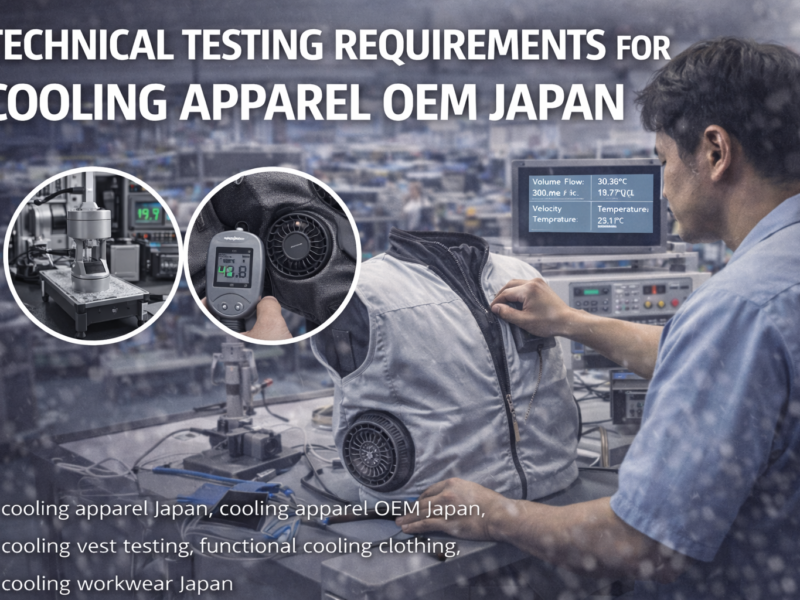
Fan-assisted cooling garments rely on consistent airflow circulation. Testing procedures measure fan speed, air volume, and battery efficiency.
Stable airflow distribution ensures that the cooling effect remains effective throughout the workday. In addition, manufacturers evaluate noise levels because Japanese buyers often prioritize quiet operation in work environments.
Battery Safety and Endurance
Cooling apparel systems require reliable power sources. Manufacturers test battery endurance to verify that cooling fans maintain stable performance during extended working hours.
Safety tests also examine overheating protection and charging stability. These procedures ensure that cooling apparel systems meet strict safety expectations.
Quality Control in Cooling Apparel Manufacturing
Beyond laboratory testing, manufacturers must implement strict production quality control. Japanese buyers expect consistency across every production batch.
Factories typically inspect:
- Fan installation accuracy
- Electrical wiring stability
- Fabric stitching precision
- Final airflow functionality
Consistent quality control prevents product defects and ensures reliable performance across large production volumes.
Why OEM Manufacturing Expertise Matters
Japanese companies often maintain long-term supplier relationships. Therefore, they prefer manufacturers who demonstrate stable production processes and continuous technical improvement.
OEM suppliers who combine engineering expertise with structured testing procedures can meet these expectations more effectively.
Furthermore, manufacturers who support customization—such as private labeling or product adjustments—gain additional advantages when working with Japanese brands.
Cooling apparel Japan demand continues to expand as companies seek reliable solutions for hot and humid working environments.
Technical testing, precise manufacturing, and stable OEM production all play essential roles in supporting this market.
Suppliers who provide verified performance data and consistent quality control will build stronger partnerships with Japanese distributors and corporate buyers.
Recent Comments