
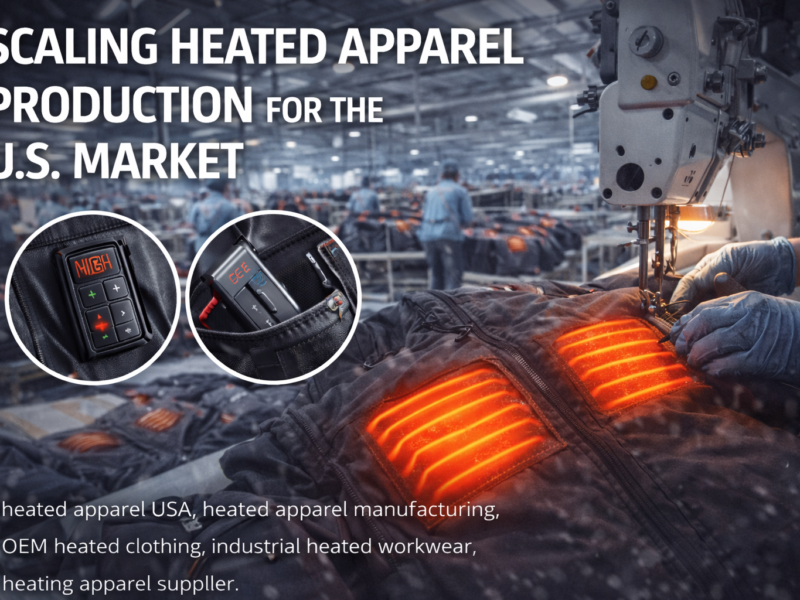
Growing Demand for Heated Apparel in the United States
Demand for heated apparel in the United States continues to expand across multiple industries. Construction companies, logistics operators, and infrastructure contractors increasingly rely on heated garments to maintain worker productivity during winter months.
As a result, many buyers now place large seasonal orders instead of purchasing small quantities. This shift requires manufacturers to support higher production volumes while maintaining consistent quality standards.
Therefore, scaling manufacturing capacity has become a critical factor for OEM heated apparel suppliers.
Production Challenges in Heated Apparel Manufacturing
Scaling heated apparel production involves more than increasing garment output. Manufacturers must coordinate several specialized components within the supply chain.
First, heating elements require stable sourcing and precise installation. Even minor inconsistencies in wiring or panel placement can affect product performance.
Second, battery systems must meet strict safety requirements. Suppliers must provide reliable battery modules with stable heating output and proper protection circuits.
Finally, factories must maintain consistent stitching quality and durable fabric construction to support industrial working conditions.
Because these components work together, manufacturers must integrate quality control throughout the entire production process.
Key Manufacturing Capabilities Buyers Evaluate
When selecting OEM suppliers, U.S. buyers typically review several manufacturing capabilities.
Large-Scale Production Capacity
Industrial buyers often require thousands of garments per order. Therefore, suppliers must demonstrate scalable production lines and experienced assembly teams.
Stable Component Supply
Reliable access to heating panels, batteries, and electronic controllers ensures consistent product output. Manufacturers who manage component sourcing effectively reduce production delays.
Structured Quality Control
Factories must implement systematic inspection procedures. These processes verify heating performance, electrical safety, and garment durability before shipment.
The Role of OEM Partnerships in Long-Term Supply
Large U.S. buyers rarely change suppliers every season. Instead, they prefer long-term OEM partnerships that provide predictable production planning.
Stable partnerships allow manufacturers to forecast demand, reserve production capacity, and coordinate material procurement more efficiently.
In addition, OEM suppliers often support product customization, including logo placement, heating zone adjustments, and packaging design.
These capabilities strengthen collaboration between manufacturers and industrial buyers.
Heated apparel USA demand continues to grow as companies seek practical solutions for winter productivity and worker safety.
Manufacturers who scale production responsibly while maintaining strict quality standards gain stronger trust from industrial buyers.
OEM suppliers that combine manufacturing stability, technical expertise, and supply chain coordination will remain competitive in the expanding U.S. heated workwear market.
Recent Comments