
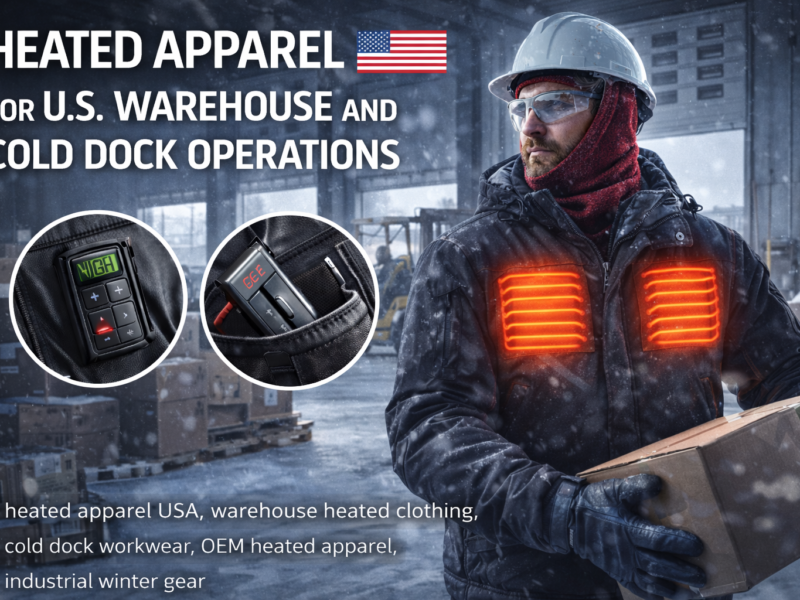
Why Warehouse and Cold Dock Work Requires Active Heating
Warehouse and cold dock environments expose workers to constant temperature fluctuations. As loading doors open and close throughout the day, cold air repeatedly enters the workspace. As a result, employees experience prolonged exposure to low temperatures, especially during winter months.
Unlike fully enclosed heated facilities, cold dock zones remain partially open. Therefore, traditional insulated jackets often fail to maintain consistent warmth during long shifts.
For this reason, many U.S. logistics operators now integrate heated apparel into their winter operational strategy.
Productivity Challenges in Cold Warehouse Operations
Cold environments reduce dexterity and reaction speed. Consequently, workers handle materials more slowly and require more frequent breaks. In addition, prolonged cold exposure increases fatigue and lowers concentration levels.
When productivity declines, warehouse throughput slows. Moreover, delayed loading schedules create downstream logistics disruptions.
Heated apparel directly addresses these challenges by stabilizing core body temperature. As a result, employees maintain steady performance during extended shifts.
Key Features Required in Heated Warehouse Apparel
U.S. warehouse operators typically prioritize three core elements:
1. Extended Battery Runtime
Shifts often last 8–12 hours. Therefore, heated garments must support long-duration battery performance or allow quick battery replacement.
2. Flexible Mobility
Workers lift, bend, and operate machinery continuously. Consequently, heated apparel must provide warmth without restricting movement.
3. Durable Construction
Frequent abrasion from packaging materials and equipment demands reinforced fabrics and protected wiring systems.
OEM suppliers who meet these requirements gain stronger traction with U.S. logistics buyers.
What U.S. Buyers Expect from Heated Apparel OEM Partners
Beyond product performance, American distributors evaluate manufacturing stability.
They expect:
- Consistent production capacity
- Transparent lead times
- Clear battery safety documentation
- Private label customization
Because warehouse contracts often involve recurring seasonal orders, buyers prefer long-term OEM partnerships rather than short-term sourcing.
Warehouse and cold dock operations across the United States require more than passive insulation.
Heated apparel USA solutions improve comfort, stabilize productivity, and support structured winter safety strategies.
OEM suppliers who combine durable design, battery reliability, and scalable manufacturing capacity will strengthen their position in the U.S. logistics sector.
Recent Comments