
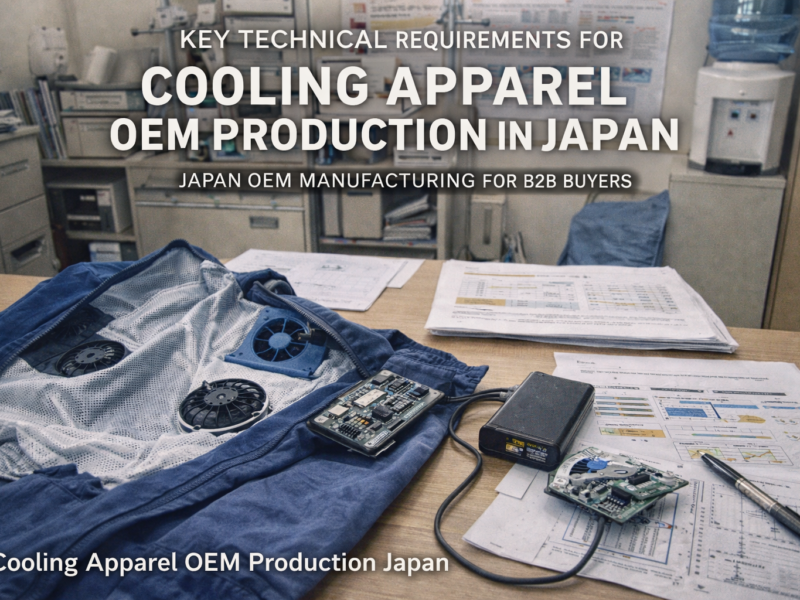
1. Japan’s Market Focus on Technical Precision
Japan’s functional apparel market emphasizes engineering accuracy and production stability. Unlike trend-driven markets, Japanese B2B buyers prioritize technical validation over marketing presentation.
As a result, cooling apparel OEM production in Japan requires structured documentation and measurable performance data.
In other words, suppliers must prove capability before discussing pricing or volume.
2. Fabric Performance and Thermal Efficiency Standards
When evaluating cooling garments, Japanese buyers begin with fabric data. Specifically, they request verified reports covering:
- Moisture absorption rate
- Quick-dry performance
- Air permeability
- UV protection
- Wash durability
In addition, cooling efficiency must remain stable in high-humidity environments. Because Japan experiences humid summers, laboratory simulations must reflect saturated air conditions.
Therefore, OEM factories should prepare standardized testing reports before sample approval.
Without documented performance validation, procurement discussions rarely proceed to the next stage.
3. Electronic Component Stability and Safety
For active cooling systems, buyers examine electronic reliability in detail. For example, they assess:
- Motor durability cycles
- Noise control levels
- Battery heat resistance
- Circuit protection design
- Overload prevention systems
Furthermore, safety documentation must be traceable and organized.
Although certification requirements differ by application category, technical transparency remains essential.
Consequently, factories without structured QC records often fail supplier audits.
4. Precision Manufacturing and Tolerance Control
Beyond material performance, Japanese companies evaluate manufacturing accuracy.
In particular, they monitor stitching consistency and size tolerance control. Even minor deviations can trigger corrective action requests.
At the same time, internal wiring alignment and seam reinforcement must meet defined production standards.
Therefore, OEM suppliers should implement standardized SOP systems and inline inspection checkpoints.
Consistency across production batches is valued more highly than aggressive expansion speed.
5. Packaging and Presentation Standards
Packaging also reflects manufacturing credibility in Japan.
While some markets focus primarily on cost reduction, Japanese buyers expect structural clarity and labeling precision.
They often require:
- Clean design structure
- Accurate multilingual manuals
- Barcode traceability
- Clear technical labeling
As a result, packaging development must align with retail channel expectations from the beginning of the project.
6. Long-Term Supplier Evaluation Criteria
Japanese companies typically prefer long-term supplier relationships. However, initial qualification processes remain strict.
Before confirming cooperation, buyers evaluate:
- Lead time stability
- Engineering responsiveness
- Communication efficiency
- Production transparency
Once trust is established, partnerships often expand across product generations.
Therefore, cooling apparel OEM production in Japan is capability-driven rather than price-driven.
Cooling apparel OEM production Japan requires technical compliance, documented testing, and manufacturing precision.
Because Japanese B2B buyers prioritize reliability and measurable standards, suppliers must demonstrate structured capability at every stage.
Ultimately, long-term success in this market depends on consistency, transparency, and engineering discipline.
Recent Comments