
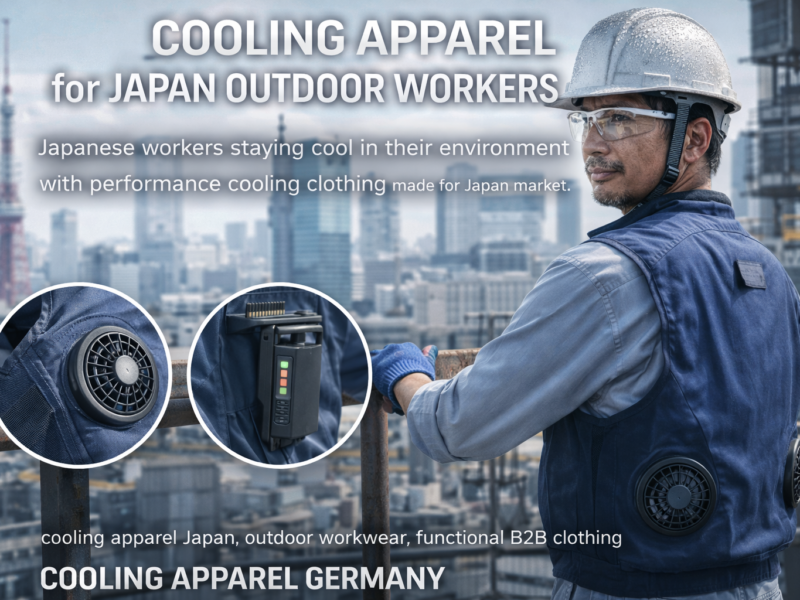
Japan’s functional apparel market is highly technical and detail-oriented. Therefore, overseas brands entering Japan must work with OEM partners who understand strict performance expectations. In particular, cooling apparel OEM production Japan projects require precision engineering, verified data, and consistent manufacturing control.
Unlike price-driven markets, Japanese buyers prioritize stability, durability, and long-term reliability. As a result, OEM suppliers must focus on technical depth rather than only cost efficiency.
1. Precise Thermal Performance Verification
First and foremost, Japanese buyers expect measurable cooling performance.
Rather than accepting general marketing claims, they require clear lab data. For example, they often request:
- Q-max testing results
- Fabric thermal conductivity data
- Moisture evaporation rate reports
- Air permeability measurements
Moreover, testing standards must be traceable. In many cases, buyers prefer results aligned with JIS standards or internationally recognized lab certifications.
Therefore, cooling apparel OEM production for Japan must include in-house testing capability or reliable third-party laboratory partnerships. Without verified data, trust becomes difficult to establish.
2. Fabric Consistency and Material Stability
In addition to performance, material stability is critical.
Japanese brands typically conduct repeat orders over multiple seasons. Consequently, they expect identical fabric hand feel, elasticity, and color fastness across production batches.
To meet this expectation, OEM factories should:
- Implement strict raw material lot control
- Maintain detailed fabric specification records
- Use standardized dyeing processes
- Perform batch comparison testing
Furthermore, documentation must be transparent. When buyers audit a supplier, they often examine process records in detail. A well-documented production system significantly increases credibility.
3. Advanced Sewing and Construction Accuracy
Cooling apparel in Japan frequently integrates technical structures such as:
- Ventilation panels
- Mesh zoning
- Seamless bonding
- Ergonomic pattern cutting
Because of this complexity, construction accuracy becomes essential.
For instance, uneven stitching or inconsistent bonding may reduce airflow performance. In contrast, precise workmanship improves durability and user comfort.
Therefore, OEM suppliers should invest in skilled technicians and automated equipment. Additionally, inline quality inspection helps prevent defects before bulk completion.
4. Battery and Component Safety Compliance
If the cooling product includes fan systems or battery-powered modules, safety standards become even stricter.
Japanese buyers typically request:
- PSE-related compliance
- Overheat protection verification
- Stable wiring integration
- Clear safety labeling
Furthermore, packaging instructions must be accurate and professionally translated. Even small labeling errors may delay import approval.
As a result, cooling apparel OEM production Japan projects require coordination between textile engineering and electronic component compliance.
5. Lean Production and Delivery Reliability
Beyond product specifications, Japanese companies evaluate operational discipline.
On-time delivery, structured communication, and stable lead times strongly influence long-term cooperation. Therefore, factories should establish:
- Clear production timelines
- Real-time order tracking
- Pre-shipment inspection reports
- Transparent sampling procedures
In addition, quick technical response during development stages strengthens buyer confidence. When revisions are handled efficiently, collaboration becomes smoother.
6. Continuous Improvement Culture
Finally, Japanese partners value continuous improvement.
Rather than focusing only on the current order, they assess whether an OEM supplier can optimize processes over time. For example, reducing defect rates, improving cooling efficiency, or enhancing fabric durability all demonstrate technical maturity.
Thus, factories that adopt Kaizen-style improvement systems often perform better in the Japanese market.
Cooling apparel OEM production Japan is not simply about manufacturing garments.
Instead, it requires structured quality control, measurable thermal performance, precise construction, and reliable compliance management.
For B2B buyers targeting Japan, selecting a technically capable OEM partner ensures long-term brand stability. Meanwhile, for manufacturers, investing in testing, documentation, and disciplined production systems creates a competitive advantage in this demanding market.
Recent Comments